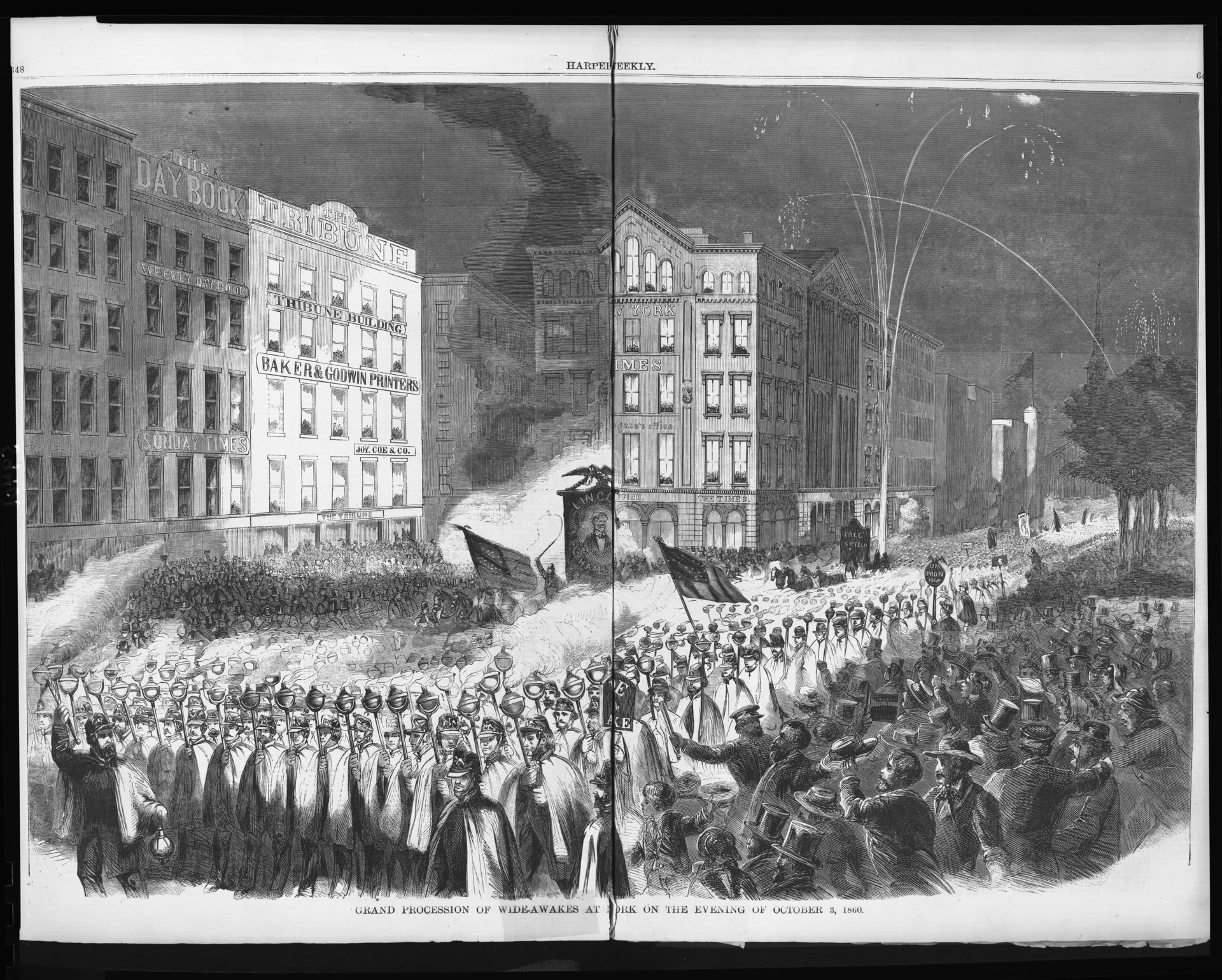

Hartford, Connecticut · 1860
The Wide Awakes
Our lab is inspired by the Wide Awakes — a movement of young men who refused to sleep through a moral emergency.
A spark in Hartford
In the winter of 1860, a handful of young dry-goods clerks in Hartford, Connecticut, volunteered to escort the antislavery orator Cassius M. Clay through the city's gaslit streets. To keep the dripping oil of their torches off their clothes, they threw on capes of black glazed cloth and caps to match. The makeshift uniform caught the public eye — and something bigger caught fire.
They marched at night
They called themselves the Wide Awakes, and they organized like an army. Clubs formed block by block, drilling in tight formation and marching after dark by the light of hundreds of torches — many mounted on split fence rails, a nod to the rail-splitter they'd come to support. Capes gleaming, lanterns swinging, they turned the night itself into an argument: disciplined, unafraid, impossible to look away from.
The all-seeing eye
Their emblem was a single open eye — wide awake. It stared out from banners, from illuminated transparencies, from the glass of their marching lamps: a promise of vigilance against the Slave Power, and a warning that the nation's conscience was watching. To be a Wide Awake was to stay alert while others slept.
“Wide awake — and watching.”
A movement, overnight
The idea spread across the North like wildfire. Within months, Wide Awake clubs had sprung up in cities and towns from New England to the western frontier, drawing in — by some counts — as many as half a million young men, many of them first-time voters. They guarded the speakers, packed the rallies, and marched for the candidates of freedom and the cause of abolition, giving a rising generation something to belong to and something worth fighting for.
Awake to the reckoning
Their torchlit discipline unsettled the South, where the marching columns looked like an army in waiting. They were not wrong. When the election was won and the war came, countless Wide Awakes traded their capes for Union blue — the drilling clubs of 1860 becoming soldiers for emancipation. The movement had been, all along, a rehearsal for the reckoning.
Why we carry the name
The Wide Awakes understood that attention is power — that how a story is carried through the streets can change what a country is willing to see.
We carry it now through screens instead of torchlight: a media lab built to keep people awake, and to keep entertaining the truth.